

An old chest of drawers can catch your eye before you know anything about its history. To tell Victorian, Edwardian and Georgian furniture apart, start with the outline: Georgian pieces often favour balance, Victorian furniture tends towards heavier decoration, and Edwardian designs usually look lighter.
Yet a polished surface and graceful legs can belong to several periods, including later reproductions. Style isn't proof of age, so follow the clues in shape, timber and detail before looking beneath the surface.
How to Tell the Difference Between Victorian, Edwardian and Georgian Furniture
The periods run in this order: Georgian, Victorian, then Edwardian. Georgian furniture spans 1714 to 1830, Victorian furniture dates from 1837 to 1901, and Edwardian furniture covers 1901 to 1910.
The gap between the Georgian and Victorian periods covers William IV's reign. However, furniture fashions rarely changed when a monarch died. Workshops continued making familiar designs, whilst customers sometimes preferred styles that were already decades old.
These dates identify British historical periods. They don't provide universal dates for furniture made elsewhere, and decorative styles continued beyond their original eras.
Georgian furniture favours balance, fine timber and careful detail
Georgian furniture often has a composed, balanced appearance. On a chest of drawers, the drawer fronts, handles and feet usually form a coherent arrangement rather than competing for attention.
Mahogany, walnut and oak all appear, although their popularity varied across the period and between workshops. Walnut is particularly associated with earlier Georgian furniture, whilst mahogany became prominent during the eighteenth century.
Look for carefully matched veneers, shaped aprons beneath table tops and well-proportioned carved details. Cabriole legs, which curve outwards near the knee and inwards towards the foot, appear on many earlier examples.
However, Georgian design changed considerably over more than a century. Early pieces can feel substantial, whilst later designs associated with Hepplewhite and Sheraton often favour straight, tapered legs and lighter outlines. Ornate Chippendale-style carving also belongs within the Georgian story.

Victorian pieces are often heavier, darker and more decorative
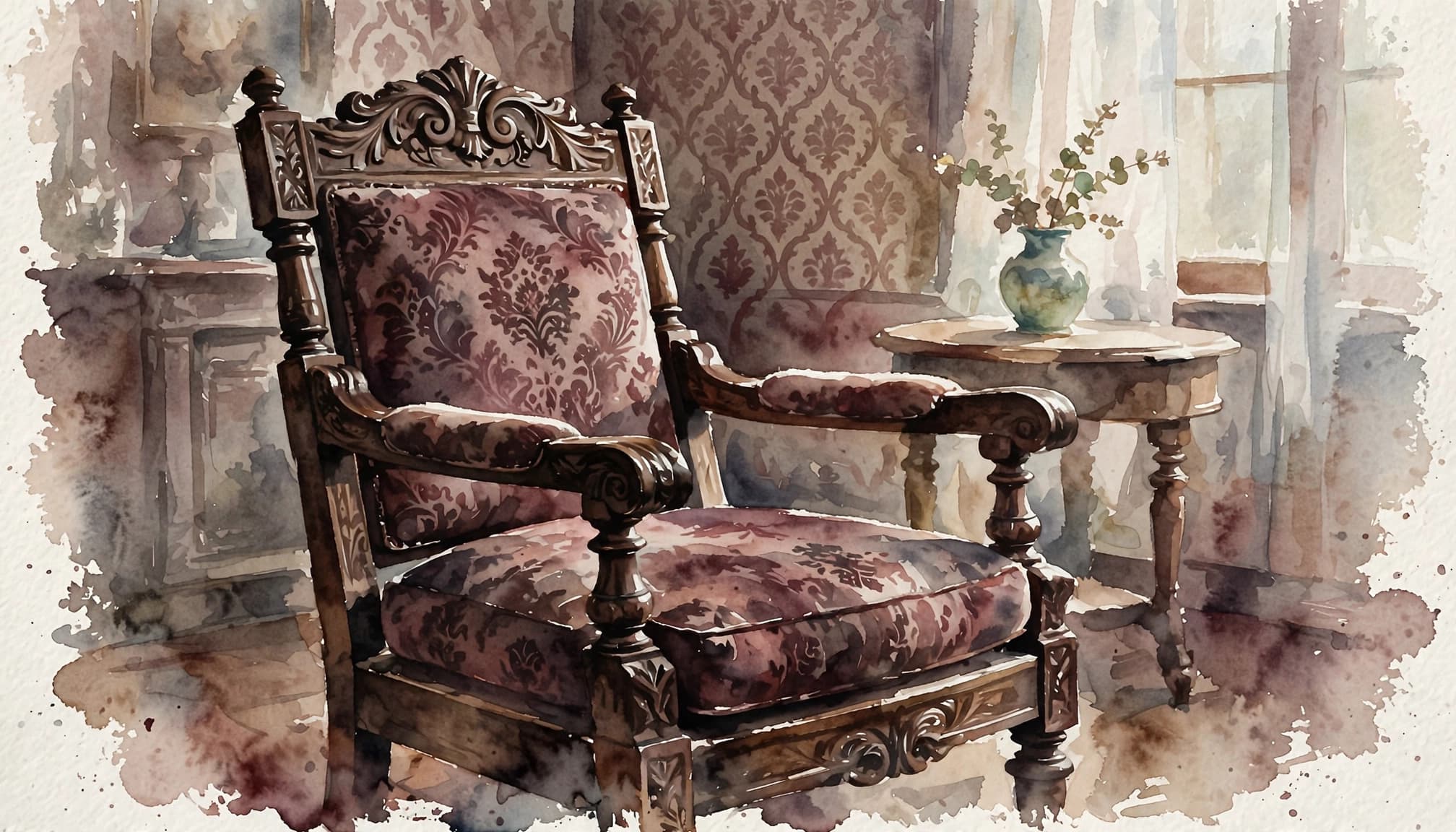
Victorian furniture frequently makes a stronger visual statement. A sideboard may have a tall carved back, thick supports and projecting mouldings. Meanwhile, an upholstered chair might combine a rounded back with exposed carved timber.
Mahogany, walnut and rosewood appear in Victorian furniture, often with rich, polished surfaces. Turned legs, scrolls, carved foliage and buttoned upholstery are familiar clues.
However, the period borrowed freely from earlier designs. Gothic Revival, Renaissance Revival and Rococo Revival furniture can look quite different, despite sharing a Victorian date.
Industrial production also widened access to furniture. As a result, Victorian pieces range from plain pine cupboards to elaborate drawing-room suites. A modest kitchen table can be Victorian without carrying a single carved flower, so don't let the grandest examples define the whole era.

Edwardian furniture looks lighter and more restrained
Edwardian furniture often brings more breathing room around the decoration. Slender legs, delicate inlay and smaller decorative motifs can make a piece feel less crowded than its Victorian counterpart.
Satinwood and lighter finishes help create this impression, as do painted surfaces. However, Edwardian cabinetmakers also used mahogany, so pale colour isn't a requirement.
Earlier Georgian designs supplied plenty of inspiration. Sheraton-style outlines, tapered legs and fine contrasting borders returned to fashionable interiors. Consequently, an Edwardian piece can resemble furniture made a century earlier.
There were exceptions to this lighter appearance. Arts and Crafts furniture could be sturdy and oak-built, whilst formal dining furniture could remain substantial. The useful distinction is often the relationship between structure and decoration, rather than how delicate a piece looks at first glance.

Compare the furniture's shape, wood and decoration
Stand back before examining a handle or carved foot. The overall silhouette usually tells you more than an isolated detail.
These broad tendencies provide a starting point, rather than a dating chart.
| Feature | Georgian | Victorian | Edwardian |
|---|---|---|---|
| Overall impression | Balanced proportions | Often substantial and decorative | Often lighter and less crowded |
| Common leg forms | Cabriole or straight tapered legs | Turned, carved or substantial supports | Slim tapered legs and revival forms |
| Surface detail | Fine veneers, carving and inlay | Bold carving and rich upholstery | Delicate inlay, painted finishes and restrained ornament |
The strongest identification comes when several features agree. A single tapered leg or dark finish can't settle the question.
Look at the silhouette and legs before the small details
Start with the furniture's outline against the wall. Notice the width of the top, the depth of the body and the space beneath it.
A Georgian chest often has an orderly arrangement of drawers within a balanced rectangular body. By comparison, many Victorian sideboards stretch upwards through raised backs, shelves or carved pediments. Edwardian occasional tables often leave more open space beneath slim tops.
Next, follow the legs downwards. Cabriole legs suggest one family of designs; turned supports, with rounded sections shaped on a lathe, suggest another. Straight legs that narrow towards the floor create a different impression again.
However, all these forms cross period boundaries. Victorian makers revived cabriole legs, and Edwardian makers revived eighteenth-century tapered designs. Even within one dining set, the table and chairs may express the style differently.
Check the timber, finish and level of ornament
Once you've read the outline, move closer to the surface. Georgian furniture often rewards attention to the grain, the arrangement of veneer and the relationship between decoration and structure.
Veneer means a thin layer of decorative wood over another timber. It isn't an automatic sign of cheap or modern construction. Cabinetmakers used veneers on fine antique furniture to display attractive grain and create patterned surfaces.
Victorian carving often produces stronger shadows, with raised scrolls or foliage standing proud of the surface. In contrast, Edwardian inlay can sit flush with the wood, adding detail without increasing bulk.
Colour needs greater caution. Staining, sunlight, polishing and restoration can alter a surface, whilst photographs can exaggerate its warmth or darkness.
Museum references help you compare similar furniture forms. The Metropolitan Museum of Art's European furniture collection highlights include chairs, tables, cabinets and sofas, rather than treating every object as interchangeable.
Upholstery is less dependable for dating because fabric, padding and coverings may have been replaced.
Use construction clues to judge a piece's age with care
Recognising a style and establishing a date are separate tasks. Victorian, Edwardian and Georgian furniture have all inspired later reproductions, some made with considerable skill.
Construction, marks and documented history can strengthen an identification. However, an old component can also form part of a later assembly.
A Georgian-style chair may be Edwardian, whilst a Victorian chair may carry much newer upholstery. Describe the style and the likely manufacture date separately.
Inspect joints, drawers, backs and signs of repair
If the furniture can be examined safely, open the drawers and look at their sides, bottoms and runners. Compare the visible front with the less polished working parts.
Dovetail joints, with interlocking wedge-shaped sections, can provide useful information about how a drawer was made. However, their presence alone doesn't establish age. Both hand-cut and machine-cut joints appear across furniture history, and skilled reproductions can imitate earlier work.
The back and underside may reveal different timbers, tool marks, replacement boards or altered fixings. These areas often tell you more about construction than the polished front, which may have received substantial restoration.
Look for wear where movement and handling would produce it. Drawer runners, feet and frequently touched edges deserve attention. Then compare those areas with protected surfaces.
A replacement drawer bottom or repaired foot doesn't make an entire piece modern. Equally, a few old boards don't prove that the complete object is antique.
Don't force a stuck drawer or turn heavy furniture unaided. A specialist can examine inaccessible areas without risking damage to the piece or injury.
Treat labels, wear and style as evidence, not proof
A maker's stamp, trade label or retailer's plaque can narrow the enquiry. Nevertheless, a label may identify a seller rather than a manufacturer, and an old label can be transferred to another object.
Read the wording as carefully as the name. Addresses, business names and printed details may help connect a piece with documented production, but the label must agree with the furniture around it.
Wear also needs context. Genuine use can leave uneven rubbing, small dents and softened edges. Yet restorers can repair those signs, and artificial ageing can reproduce them.
An attractive patina, meaning the surface character developed through age and use, deserves appreciation without becoming a dating certificate.
For American pieces, use American comparisons alongside British period names. The DAR Museum's furniture styles presentation covers examples dating from 1660 to 1940, providing a broader historical reference.
Where a purchase carries significant value, we recommend an independent furniture specialist or qualified antiques dealer. Ask for an assessment of likely date, alterations and condition together. Those findings matter more than a confident period label alone.
Read the Whole Piece Before Naming the Period
Georgian furniture often feels balanced and carefully proportioned. Victorian pieces commonly have darker surfaces and bolder decoration, whilst Edwardian designs tend towards lighter outlines and more restrained detail.
Keep those distinctions in mind, then test them against the timber, construction and any surviving marks. Several agreeing clues provide a stronger basis than one familiar foot, handle or finish.
Styles overlap, repairs change appearances and reproductions borrow freely. The most convincing identification explains the whole piece, including the parts you don't see when you first walk into the room.


